What the builder put on the door
The tract houses on the flat streets around the old cannery went up quickly and to a plan, and the hardware went on the same way. The front door got a knob with a keyway in it and nothing above. The back door got a knob, sometimes without a key. The door between the garage and the kitchen got the cheapest passage latch in the catalogue. The garage roll-up got a T-handle with a small wafer lock. There was no deadbolt anywhere on the house, because in 1954 nobody selling a tract house was expected to fit one.
Almost every one of these houses has been added to since. A deadbolt appeared on the front door around 1985, another on the back a few years later, a screen door somewhere in between, and a second deadbolt when the daughter moved back in. The result is a door with two or three cylinders on different keys and a ring that has been carried for years without anyone asking what each one opens. The first honest job on a house like this is not selling hardware. It is a count and a rekey at $24 to $39 per cylinder, so that one key opens the front, the back, the garage side door and the yard gate, and every old key on every old ring stops working.
The screws in the strike
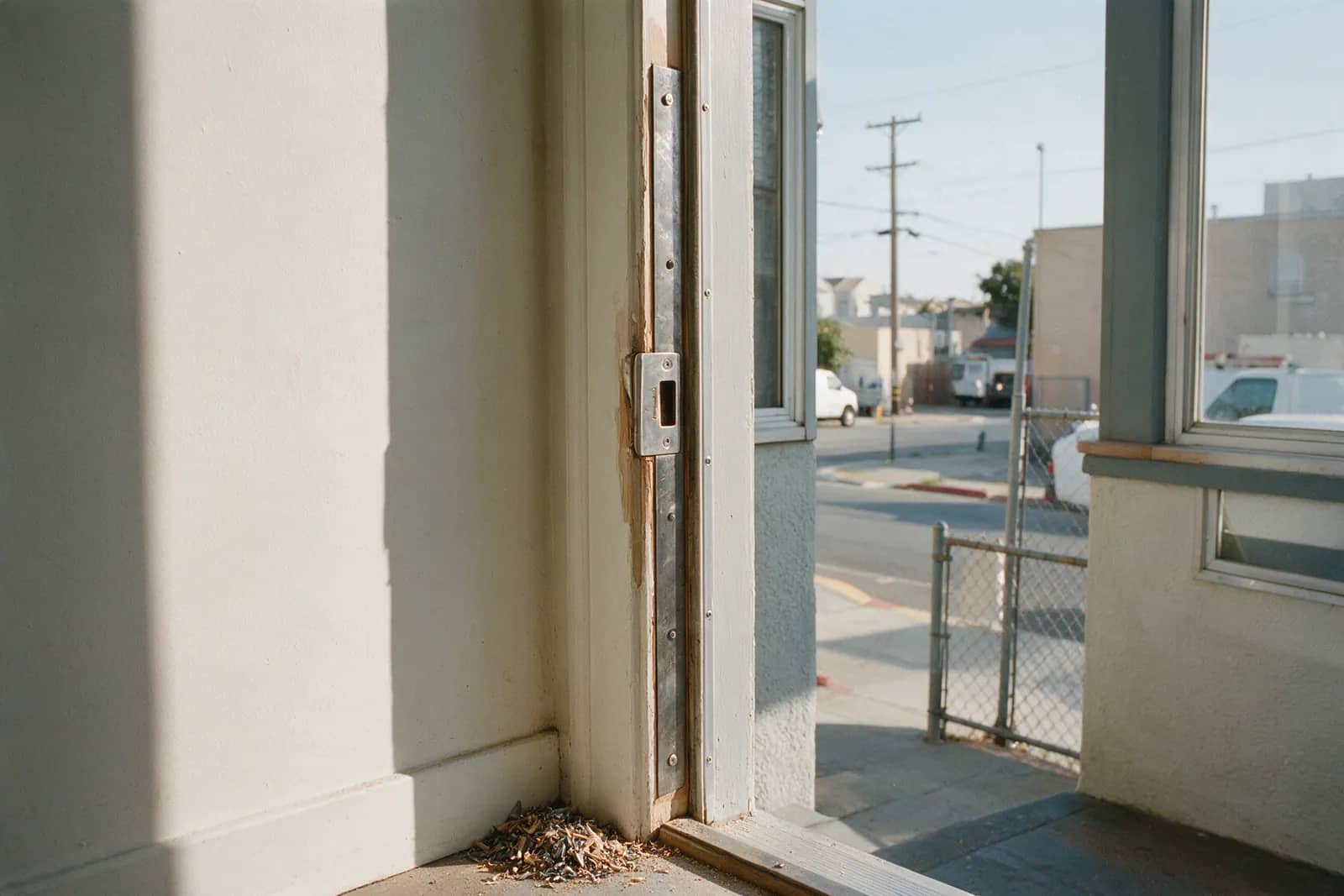
Here is the cheapest improvement available on a Burbank house, and it costs almost nothing. The deadbolt that was added in the eighties throws a solid bolt an inch into the frame, which is fine. What holds that bolt is a small steel strike plate screwed to the jamb with two screws three quarters of an inch long. The jamb is a thin board nailed to the framing behind it, and those short screws never reach the framing. A shove that no bolt would fail lifts the whole strike out of a piece of pine.
Two three-inch screws through the strike and into the stud behind it change what the door can take, and they go in during any visit that is already happening. The same applies to the hinge screws on the outer hinge leaf. Where the jamb has already split from an earlier attempt, or where a door has been forced, the repair is $155 to $399 and covers the jamb, the strike, the cylinder and whatever else took the load, described on the receipt in plain words for an insurer. Nothing about this is dramatic; it is carpentry with a screwdriver, and it does more for the house than any lock on the shelf.
The door from the garage
The single most common lockout call from these streets is the door between the garage and the kitchen. It has a spring latch, it shuts on its own, and the household comes and goes through it because that is where the car is. The roll-up goes down, the kitchen door has already latched, and the family is standing on the driveway. That is a house lockout at $115 to $199, opened without damage, and where the garage has a side door to the yard that one is tried first.
This door is also the one to put a keypad on, if a keypad is wanted at all. A smart lock at $169 to $429 on the door from the garage gives a code to a caregiver, a dog walker, a teenager or a contractor, retired the day the arrangement ends, while the front door keeps a cylinder and a key. Households do this far more often than they put a keypad on the front, and it is the right way round: the front door is what the street sees, and the garage door is what the family uses. A mechanical key stays under the keypad for the day the batteries die, which they eventually do.
What a rekey does and does not do
A rekey ends the history of a house: the keys given to a tenant in 2011, the copy the previous owner's brother still has in a drawer, the key hidden under the pot by the hose that everyone on the street knows about. It changes the pins and leaves every visible part of the door alone, at $24 to $39 per cylinder. On a tract house the count is short, four or five, which keeps the figure short.
What a rekey does not do is fix a tired lock. If the knob turns loosely and the latch comes back slowly, that is wear inside the lock and it will not improve. If the key has to be jiggled, the plug is worn and a rekeyed plug is a worn plug with new pins in it. The honest sequence is to say which cylinders are worth rekeying and which are past it, with the lock in hand and the plate off, before anything is bought. On most of these houses the deadbolts are worth keeping and one of the original knobs is not.
When a lock is genuinely finished
Replacement is $109 to $289 per door and the make and grade are named before it goes on. Two details matter on a house of this age. The backset, the distance from the edge of the door to the center of the bore, is either two and three eighths or two and three quarters, and the wrong one leaves a hole that does not line up with anything. And the bore itself on the oldest untouched doors is sometimes smaller than the modern standard, so a new knob needs the hole opening slightly, which is ordinary work but should be mentioned before it happens rather than after.
The other thing worth saying on these houses is that the front door is often still the original slab, and it is usually in better condition than the hardware on it. A 1954 door that has been painted eleven times is fine. It does not need replacing so that a new lock can go on it. Where a door has warped enough that the bolt binds, the strike is moved or the edge is eased, and that comes before any talk of a new door.
The rest of the count, and the cannery blocks
The doors people forget when they call are the yard gate, the garage side door, the shed at the fence, and the roll-up T-handle. Each is a cylinder and each takes a key somebody was given at some point. Counting them on the call is what keeps the figure from moving later. A safe in the garage, bought years ago and last opened by somebody who has since died or moved, is opened at $175 to $479, usually without harm to the door.
On the cannery blocks the buildings are newer and the pattern is different: a garage under the unit, a common entry, a mailbox in the lobby, and units that turn over on leases. Rekeys there are the same $24 to $39 per cylinder, booked by the owner or the manager, and several units in one building share the $89 visit. Whichever kind of building it is, the Eden Rule is the same. The figure is said on the call and covers the visit, the labor and the parts. The same figure is on the receipt whatever the technician finds at the door. The lock is opened without damage first, and drilling happens only after you agree and never for a higher figure. Payment is card or tap at the door, with an itemized receipt by email and a written line for an insurer, an owner or a manager when one is needed.
Quick answers
Is the original 1950s hardware on my Burbank house worth keeping?+
Usually the deadbolts added later are worth keeping and rekeying at $24 to $39 per cylinder, while a builder's knob with a worn keyway that has to be jiggled is past it and is replaced at $109 to $289. Which is which is said with the lock in hand and the plate off, before anything is bought.
What is the cheapest thing I can do to make the front door harder to force?+
Replace the two short screws in the deadbolt strike, and one screw in the outer hinge leaf, with screws long enough to reach the framing behind the jamb. It takes minutes and goes in during a visit that is already happening. Where a jamb has already split, the repair is $155 to $399.
Which door should a keypad go on?+
The door from the garage into the house, at $169 to $429, since that is the door the family actually uses and codes can be issued and retired for a caregiver, a dog walker or a contractor. The front door keeps its cylinder, and a mechanical key stays under the keypad for flat batteries.
Need it handled rather than read about?
(510) 876-9668More guides